
Welcome to a practical guide that helps investors read price and volume to make clearer decisions in U.S. markets. This article explains how market behavior shows up on charts and why many traders use these signals to plan entries and exits.
Technical analysis grew from Dow Theory and rests on three ideas: markets discount information, price moves in trends, and patterns can repeat. Top brokerages now offer live data, robust charts, and learning tools to practice these methods at low cost.
This guide sets realistic expectations: this is a decision-support framework, not a prediction tool. Results and performance depend on disciplined rules, risk controls, and consistent process. You will learn moving averages, oscillators, trendlines, channels, pivot points, and Fibonacci levels—then see how analysts turn them into strategies.
Focus on what the market shows—price and volume—so you can respond faster than waiting on fundamentals alone. Remember: past patterns may not predict future outcomes, so risk management is essential before trading live.
Key Takeaways
- Learn to read price and volume to make objective trading choices.
- Market psychology drives patterns; charts show that behavior.
- Tools include averages, oscillators, trendlines, pivots, and Fibonacci.
- Platforms with live data and charting help U.S. traders practice.
- Use this guide to build a disciplined plan and strong risk controls.
Technical analysis basics for beginners
Beginner traders learn best by watching how price and volume tell a market’s story. This section explains the core ideas so you can read charts with confidence and find clearer entry points.

What it means: price, volume, and market behavior
Technical analysis studies price moves and volume patterns on a chart to spot supply and demand shifts. Traders use these signals to identify likely turning points and to time trades across stocks, forex, commodities, and crypto.
How this differs from fundamental analysis
Fundamental analysis values a security using earnings, balance sheets, and macro information. By contrast, chart-based work focuses on current prices and the behavior of participants reflected in the data.
Why past performance informs but does not guarantee
Historical patterns improve probability but do not ensure specific future results. A breakout, for example, may attract traders; confirmation with volume and a clear rule helps avoid false moves.
- Core tools: moving averages, trendlines, oscillators, and chart patterns.
- Time frames: watch higher and lower charts to manage risk.
- Mindset: build rules, size positions, and use stops to protect performance.
Core principles that underpin the discipline
Markets leave clues in every tick of data; mastering those clues starts with clear principles.
The market discounts everything and why that matters
The idea that the market discounts everything means current price already reflects fundamentals, macro forces, and trader psychology.
Technical analysts focus on what prices do instead of revaluing a security every time news appears.
This lets analysts react fast to new information and adapt strategies without re-underwriting a company or asset.
Trends and repeating patterns: the foundation of trading strategies
Trends are persistent directional moves visible across different time frames.
Many strategies assume continuation is more likely than sudden reversal, so identifying trend direction is central.
Repeating patterns arise from common emotions—fear, greed, and herding—which create breakouts, pullbacks, and consolidations that traders can measure.
- Context matters: a pattern is more reliable when it aligns with the dominant trend and volume or momentum supports the move.
- Price rules: when prices invalidate a setup, disciplined traders exit rather than argue with the market.
- Design strategies: build rules for direction, signal strength, and clear invalidation before entering a position.
Even in noisy short-term data, repeated behavior can yield an edge if you use risk controls and document outcomes across securities—from equities to currencies and commodities.
Reading charts and time frames like a pro
Charts are the quickest language traders use to read price moves and shift decisions in real time.
Candlestick charts encode four values per bar: open, high, low, and close. The body shows open-to-close change while wicks mark intrabar extremes. That layout makes pattern recognition faster than traditional bar lines.
Doji candles signal indecision. Variants include long-legged, dragonfly, gravestone, and the rare four-price doji. Alone they do not confirm a reversal; context after a long move matters most.
Combine a doji with confirmation — a clear follow-through candle, rising volume, or an indicator shift — to reduce false signals. Strong confirmation preserves capital and improves entry timing.

Choosing time frames and aligning multiple views
Common frames: 5-minute, 15-minute, hourly, 4-hour, and daily. Day traders prefer shorter charts; swing traders use 4-hour to daily to capture bigger moves.
Short frames give more signals but more noise. Higher frames produce cleaner structure but fewer opportunities. Match your rules to the frame you trade.
- Multi-time-frame method: spot the bias on the daily, refine levels on the 4-hour, and trigger entries on the 15-minute.
- Workflow example: daily sets trend, 4-hour finds support, 15-minute times the pullback entry.
- Consistency: keep chart templates, colors, and scales stable so signals stay comparable across time.
Key technical analysis tools and indicators
A compact toolkit helps traders translate price moves into clear trade decisions.
Moving averages smooth price data and define trend direction. Simple (SMA) and exponential (EMA) averages act as dynamic support and resistance. Use 10/50 for short momentum, 50/200 for long bias, and note that 100–200 period lines often carry extra weight for many traders.
Trendlines, channels, and chart patterns
Draw trendlines to frame swings and channels to track orderly moves. Breakouts or pullbacks to these lines reveal entries and exits with clearer risk points.
Oscillators and momentum indicators
RSI flags overbought/oversold zones and divergence. MACD shows momentum shifts; surges confirm strong moves. Stochastics help time ranges, and ADX measures trend strength so traders avoid weak setups.
Pivot points and Fibonacci tools
Pivot levels (S1–S3, R1–R3) map intraday support and resistance. Fibonacci retracements (23%, 38%, 62%, 76%) spot pullback zones; extensions (126%, 138%, 162%, 176%) help set profit targets beyond prior highs or lows.
Combine tools: a pullback to the 50 EMA that aligns with a channel line and a 38% retracement often improves the odds. Still, let price lead—indicators complement but do not replace structure.

| Tool | Primary use | Common settings / levels |
|---|---|---|
| Moving averages | Trend direction, dynamic support/resistance | 10/50, 50/200, 100/200 |
| Oscillators | Momentum, overbought/oversold, divergence | RSI (14), MACD (12,26,9), Stochastics (14,3) |
| Pivot points | Intraday support/resistance map | S1–S3, R1–R3 from prior H/L/O/C |
| Fibonacci | Pullback entries and extension targets | Retrace: 23/38/62/76% | Extensions: 126/138/162/176% |
Support, resistance, and finding entry exit points
Start with larger charts to find strong zones that often steer shorter-term price moves.
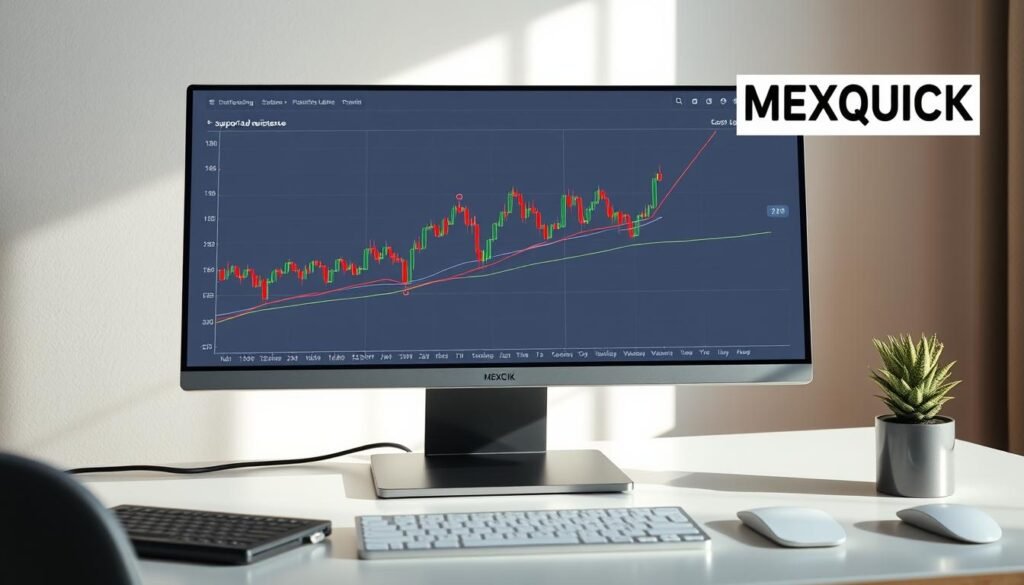
Mapping key zones across higher time frames
Mark multi-touch support and resistance on daily and 4‑hour charts first. These frames reveal durable lines that often control future price action.
Refine those zones on lower charts for tactical entries. The more times a zone holds, the stronger it becomes—until it breaks and flips role.
Confirmation tactics: waiting for break, retest, or divergence
Wait for a clear break and retest with rejection candles or confirm with momentum divergence on RSI or MACD.
“Confluence—structure, momentum, and volume—raises the odds of a clean setup.”
Use pivot levels and Fibonacci retracements to refine likely reaction areas before committing capital.
Example trade setups: buy the dip vs. breakout strategies
Example: spot a rising channel on the 4‑hour chart. Look for a pullback to channel support that lines up with a 38% Fibonacci retracement and a pivot level. Then seek an entry trigger on a 15‑minute higher low.
- Place risk under the invalidation line (below support or swing low).
- Use partial entries near the level and add on confirmation to manage risk.
- Track failed breakouts; they often create fade opportunities.
| Step | What to check | Practical rule |
|---|---|---|
| Map higher frames | Daily & 4‑hour zones | Mark multi-touch lines as primary zones |
| Confirm | Break + retest, divergence, volume | Wait for a clean rejection candle or indicator confirmation |
| Execute | Lower-time entry trigger | Entry on higher low; stop under invalidation |
Journal every entry and exit. Over time, data—not anecdotes—will refine your strategy and improve trade decisions.
Using technical analysis alongside fundamentals
A clear fundamental thesis guides what markets may do; price and charts tell you when to act.
Blending news and charts to refine timing
Form a thesis from evidence—say, an oil supply shock that should lift crude prices and help commodity currencies. Then watch price charts for confirmation before entering.
The 2020 oil collapse and recovery is a useful example. As oil fell, CAD weakened versus USD; when oil rebounded, the pair trended back. Aligning that macro view with chart structure and indicators helped traders time entries and manage risk.
Choosing brokerage platforms and charting tools in the United States
Pick brokers with reliable live data, deep indicator libraries, custom alerts, and consistent mobile/desktop features. Good order routing and low slippage matter during news spikes.
- Use economic calendars and real-time news feeds; let price confirm the narrative.
- Build intermarket watchlists: commodities, yields, and major indices that move your target.
- Back-test and forward-test how catalysts interact with your rules to avoid hindsight bias.
| Focus | Why it matters | Practical check |
|---|---|---|
| Fundamental thesis | Sets directional value | Document driver and expected price path |
| Chart confirmation | Provides timing | Wait for break, retest, or indicator confirmation |
| Platform quality | Execution & data stability | Verify live feed, alerts, and spreads during news |
Risk note: always default to what price shows when correlations fail, and tighten rules around high‑impact events to control slippage and exposure.
Challenges, limitations, and risk management
Markets can behave like a mirror and a mystery at once, rewarding discipline more than clever signals.
EMH, random walks, and the self-fulfilling critique
Academic critics note that the Efficient Markets Hypothesis suggests historical price and volume data often reflect available information, which limits persistent edges. Random walk theory adds that many price moves are effectively unpredictable.
Some argue patterns are self-fulfilling: widely watched levels can attract clustered orders and short-term moves. That effect can be real, but it does not replace broader flows that drive lasting trends.
Why risk controls, stops, and position sizing matter more than any single indicator
Practical traders reframe these critiques by focusing on execution and loss control. Position sizing and predefined stops cap downside and protect capital.
One indicator should never override risk limits. Build rules for where you exit if wrong, how you trail winners, and what events pause new trades—especially after big news.
Regulatory and operational reminders for U.S. readers
Treat this material as educational, not individualized advice. Past performance is not indicative of future results.
Understand your broker’s regulatory membership and the scope of oversight. Some products, including certain spot virtual currency markets, sit outside NFA authority.
“Survival is the first objective: manage losses, control costs, and keep trading to let skill compound.”
- Use a checklist: trend context, level confluence, momentum confirmation, liquidity check, and minimum risk/reward.
- Mitigate operational risks with limit orders, redundant connections, and avoiding thin liquidity to reduce slippage and gaps.
- Document every trade and scenario-plan exits and scaling rules to preserve capital and learn consistently.
Conclusion
A concise roadmap helps traders turn chart clues into disciplined, testable rules. This conclusion recaps that technical analysis translates price and volume into repeatable signals. Use this guide to build simple routines: map higher frames, set clear invalidation, and log every entry and exit.
Start lean: one trend filter (moving averages), one momentum gauge (RSI or MACD), and two structure tools (trendlines and Fibonacci). Test your approach across markets and time frames, then specialize where your rules perform best.
Put risk first: size modestly, define stops, and seek favorable reward-to-risk. Patterns and indicators hint at future price direction, but uncertainty remains. Document learning, demo-test your plan, and only move to live trades when rules prove consistent. This article is educational—always do your own analysis and ensure strategies fit your objectives and tolerance.
FAQ
What does technical analysis mean when it refers to price, volume, and market behavior?
It’s a method that uses price charts and trading volume to gauge investor sentiment and probable short-term moves. Traders look for patterns, trend direction, and momentum shifts on charts to time entries and exits rather than relying on company financials or macroeconomic models.
How does chart-based work differ from fundamental analysis?
Chart-based work focuses on market data — price and volume — to identify opportunities, while fundamental work examines company earnings, balance sheets, and industry drivers to estimate intrinsic value. Many investors combine both: fundamentals for what to buy, chart signals for when to buy.
If past price action is used, why doesn’t it guarantee future moves?
Markets evolve and unexpected news can change sentiment instantly. Historical patterns increase the probability of an outcome but cannot foresee new information or regime shifts, so traders use risk controls to manage the inherent uncertainty.
What does the phrase “the market discounts everything” mean and why is it important?
It means current prices reflect all known information, including fundamentals and sentiment. This idea supports the use of price charts as a consolidated source of market consensus, helping traders act on what the market already believes rather than isolated reports.
How do trends and repeating patterns form the basis of trading strategies?
Trends show sustained buying or selling pressure; repeating patterns — like flags, head-and-shoulders, or double tops — indicate potential continuation or reversal. Traders design rules around these structures to capture moves and manage risk.
What are candlestick charts and which reversal signals are common?
Candlesticks display open, high, low, and close for each period and reveal short-term sentiment. Common reversal signals include dojis, engulfing patterns, and hammer or shooting-star shapes that suggest a shift in momentum.
How should traders choose time frames from 5-minute to daily charts?
Choice depends on strategy and time available. Day traders prefer 1–15 minute charts for quick decisions; swing traders use 1-hour to daily charts to capture multi-day moves. Aligning chosen time frame with risk tolerance and holding period is essential.
Why align multiple time frames and how does that help confirmation?
Using higher and lower frames reduces false signals. For example, a daily uptrend gives context, while a 1-hour pullback can provide a lower-risk entry. Alignment increases probability by ensuring shorter-term moves follow the bigger trend.
What role do moving averages and crossovers play in strategy (SMA, EMA, 50/200)?
Moving averages smooth price to show trend direction and dynamic support or resistance. Crossovers, like the 50/200, signal trend shifts when a faster average crosses a slower one. Traders use them for trend filters, entries, and exits.
How are trendlines, channels, and chart patterns used in practice?
Trendlines connect swing highs or lows to define trend slope; channels mark parallel boundaries. Breaks or bounces at these lines inform trade decisions. Classic patterns (triangles, wedges) help traders anticipate continuation or reversal.
When should oscillators and momentum indicators like RSI, MACD, or Stochastics be applied?
Use oscillators to spot overbought/oversold conditions, momentum shifts, or divergences that signal weakening trends. MACD shows trend and momentum, RSI highlights extremes, and Stochastics pinpoints short-term turning points. Combine with price action for validation.
How do support and resistance and pivot points help set targets and stops?
Support and resistance are horizontal price zones where supply or demand has historically changed the direction. Pivot points provide calculated intraday levels for entry, stop, and target placement. These zones guide risk placement and profit-taking.
What are Fibonacci retracements and extensions used for?
Fibonacci tools estimate likely pullback levels and extension targets based on recent swings. Traders use common ratios (38.2%, 50%, 61.8%) to identify confluence areas for entries, stops, or profit exits when combined with other signals.
How do you map key zones across higher time frames to find entry and exit points?
Start with weekly or daily charts to mark major support and resistance, then refine entries on lower frames where price reacts to those zones. Higher-timeframe levels carry more weight, so aligning lower-frame setups there improves trade quality.
What confirmation tactics — break, retest, or divergence — are most reliable?
Waiting for a clean break with volume, a successful retest holding the level, or a momentum divergence on an oscillator provides stronger confirmation than acting on the initial move alone. Combining two tactics often yields better odds.
Can you give example setups like buying the dip versus breakout strategies?
Buy-the-dip: look for pullbacks to a rising 50-period average or prior support with bullish candlesticks and rising momentum. Breakout: wait for a decisive close above resistance with volume and a retest that holds, then enter with a stop below the breakout level.
How should traders blend market news and charts to refine timing, such as oil influences on FX?
Use macro updates and sector news to set context, then let charts time entries. For example, oil price moves can drive energy stocks and certain currencies; monitor those correlations and confirm with price structure before trading.
What should U.S.-based traders consider when choosing brokerages and charting platforms?
Prioritize regulated brokers with clear fee structures, reliable order execution, and strong customer support. Choose charting platforms that offer advanced drawing tools, multiple timeframes, indicator customization, and fast data feeds.
What are common critiques like the efficient market hypothesis and the self-fulfilling prophecy?
Critics argue that markets are efficient or that patterns work because many traders follow them. Both points matter, but many practitioners accept shorter-term inefficiencies and use repeatable, rule-based approaches with strict risk management.
Why are risk controls, stops, and position sizing more important than any single indicator?
No tool predicts every move. Consistent use of stop-loss orders and sensible position sizing preserves capital during inevitable losing streaks. Risk controls determine long-term survival and performance more than any entry indicator.
What regulatory and risk reminders should U.S. traders keep in mind?
Trading carries risks and past performance doesn’t guarantee future results. Use educational resources, follow SEC and FINRA guidance, understand margin rules, and treat strategies as learning tools before risking significant capital.