
Start with clear goals. Decide why a person wants to enter the stock market and how much they can set aside regularly. This creates a realistic view of growth and keeps choices practical.
Understand that trading and other activity carry real risks. Prices move fast because of supply and demand, earnings, interest expectations, and policy news. Margin use raises risk and data feeds may be delayed, so a single price print can mislead execution.
Build simple habits: keep cash and savings for emergencies, use a diversified portfolio, and start small. Learn basic analysis, asset allocation, and time horizons before increasing exposure.
Think of investment as a disciplined process, not a one-time bet. The following sections will explain core concepts, how stocks and bonds work, practical strategies, and risk-aware steps to help new investors navigate Wall Street and the wider world of business.
Key Takeaways
- Set clear goals, regular contributions, and realistic growth expectations.
- Recognize risks and start small with a diversified portfolio.
- Keep cash reserves to avoid selling at bad times.
- Use analysis and patience over headlines from Wall Street.
- Know that price data can lag; plan trades carefully.
- Follow written goals, risk limits, and rebalancing rules.
Getting Started with Investing: Core Concepts and Your First Steps
Set concrete financial goals and match each to a time horizon before you buy a single share. Write specific targets—home down payment, retirement, or a short-term purchase—and note how long until you need the money.
Define goals, timelines, and risk tolerance
Translate goals into a written strategy. Decide how much of your portfolio will sit in stocks, bonds, and cash. State rebalancing rules and how you will react to market swings.
Building your safety net: cash savings and emergency funds
Keep 3–6 months of essential spending in a high-yield savings account so you won’t sell at the wrong time. Automate contributions to IRAs or a 401(k) to capture tax benefits and steady return potential.
- Be honest about risks: if a 20% price drop would force you to sell, reduce stock exposure.
- Record buys and the reasoning to improve future analysis.
- Favor broad-market funds for core holdings and watch costs like expense ratios and spreads.
Understanding the Stock Market, Bonds, and World Markets
Markets bundle ownership, credit, and macro signals into prices you can track every day. Stocks represent partial ownership in a business; a bond is a loan to a company or government. Together they form the core building blocks of a diversified portfolio across the world.
How indexes and exchanges show breadth
The s&p 500 and Dow Jones aggregate large U.S. firms on Wall Street and offer a quick read on broad return drivers. Other indices — DAX, Nikkei 225, FTSE 100, Hang Seng — reflect regional business cycles and currency effects investors should watch.
Reading a market snapshot
A quoted price is the most recent trade; percent change shows short-term sentiment; repeated moves build long-term return and volatility patterns. Recent snapshots show varied levels: Dow 46,758.28 (+0.51%), Nasdaq 100 24,785.52 (-0.43%), Nikkei 47,944.76 (+4.75%).
Cross-asset signals and macro drivers
Falling bond prices often mean rising yield and shifting interest expectations, which can pressure stock multiples. Gold strength may signal a safety bid or concerns about inflation. Single-session records mask dispersion — Apple rose while Amazon.com and Nike fell — so avoid reacting to one record without broader context.
- Watch: index levels, yields, sector leadership, and currency trends for consistent signals.
- Remember: exchanges differ in hours and rules, so cross-market comparisons need session and currency context.
- Use data to form disciplined views rather than chasing headlines.
investing Strategies for a Resilient Portfolio
Balancing broad exposure and targeted bets creates steady growth potential for a resilient portfolio. Use a clear strategy to set a low-cost core, then add focused positions to seek extra return. Recent market cues—S&P 500 futures 6,785.50 (+0.32%), Nasdaq 100 futures 25,195.00 (+0.81%), and WTI crude at 61.53 (+1.07%)—show why themes matter.

Passive vs. active: index funds, ETFs, and when trading makes sense
Passive funds track benchmarks like the S&P 500 via index funds or ETFs to capture market return at low cost and with minimal trading. They suit investors who want broad stocks exposure and simple rules.
Active approaches buy specific stock opportunities based on fundamentals or price trends. Active trading can work when a trader has a repeatable edge, strict risk controls, and clear analysis behind each position.
Core-satellite framework and execution details
Use a low-cost core for stability, then add satellites in areas such as technology or oil to seek extra growth. Choose liquid ETFs with tight spreads and stable tracking. Verify price deviations from NAV remain small during normal market hours and place trades in high-liquidity windows to lower costs.
- Measure success: compare portfolio return to a relevant benchmark after fees, taxes, and slippage.
- Process: predefine position size, stop-loss rules, and rebalancing bands; document analysis to avoid impulse moves.
- Trim satellites: after outsized moves lock profit but keep long-term allocation in mind.
Diversification by Sector, Asset Class, and Geography
Organizing holdings by economic sector gives a quick read on where your exposure—and risk—actually sits.
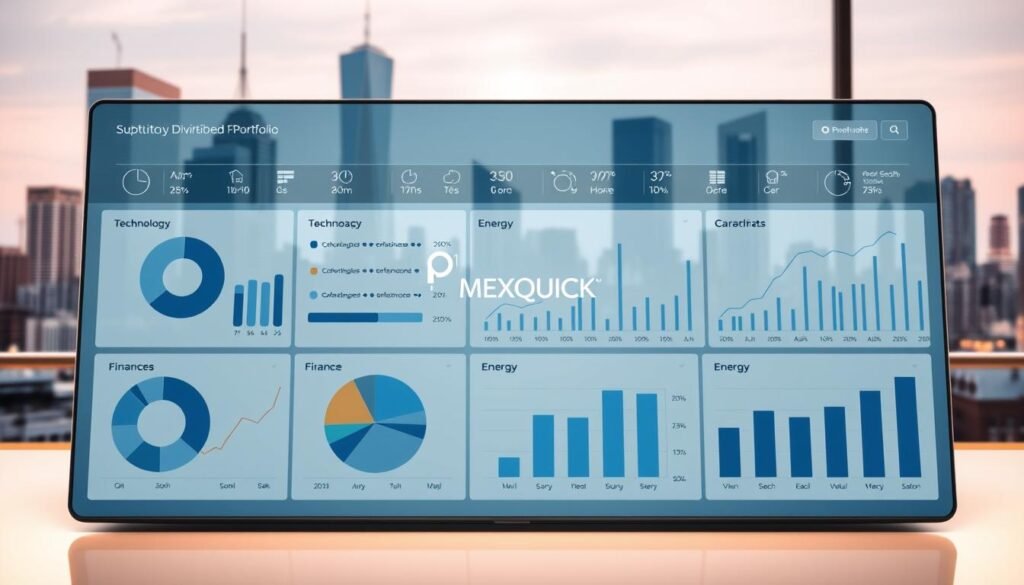
Use a concise sector breakdown to see how your stocks map to areas like technology, energy, healthcare, and financials. That view helps you assess stock exposure at a glance and spot concentration in any one company or theme.
Sector breakdown: what it is and how it helps assess stock exposure
Define a sector breakdown as a clear map of each holding by industry. A simple table shows weightings and flags if one sector dominates.
- It helps you assess stock exposure and rebalance toward a balanced value and growth mix.
- Use sector ETFs to tilt without creating single-company concentration.
Mixing stocks, bonds, and cash to manage risk and smooth returns
Combine stocks with bond holdings and cash to reduce volatility. Bonds dampen swings; cash gives optionality to buy during drawdowns.
Set clear target ranges and rebalance when a sector or asset class drifts above limits. This captures gains and keeps overall return risk in check.
Global diversification: why world markets beyond Wall Street matter
A U.S.-only portfolio can miss growth abroad and concentrate risks tied to one exchange or market cycle. Add world exposures to diversify earnings and currency effects beyond Wall Street.
Link sector weights to macro themes—technology cycles, oil supply shifts, or healthcare innovation—to ensure your allocations match conviction and tolerance for risks.
Risk, Data, and Decision-Making in the Stock Market
Not all quoted numbers reflect the price you will pay; knowing why matters for every trade. Treat displayed feeds as tools, not guarantees, and build controls that respect data limits.

Market data caveats: real-time vs. indicative prices
Indicative quotes can lag or differ from an executable price on a stock exchange. Use verified real-time feeds for order placement and confirm liquidity before you trade.
Remember: trading on margin magnifies losses and slippage can change execution price fast. Recent snapshots show mixed moves—Dow Jones +0.51%, Nasdaq 100 -0.43%—and VIX at 17.66.
Event risks: government shutdowns, tariffs, and policy moves
Political events—government shutdown debates, new tariffs, or an unexpected rate cut—shift rates, yield expectations, and inflation outlooks across Wall Street.
“Plan for the shock, then size positions to survive it.”
- Confirm data freshness, instrument liquidity, and acceptable price ranges before a busy day.
- Model tariff effects on global supply chains and prepare contingency exits.
- Tie interest and yield moves to valuation changes; avoid binary bets and document your analysis.
Conclusion
Finish by turning broad ideas into a compact, repeatable habit for your portfolio. Pair a low-cost S&P 500 core with clear goals, steady contributions, and disciplined rebalancing to let compound return work for you.
Diversify across stocks, bond holdings, and world markets. Add modest satellites like oil or thematic positions only when they match your risk plan.
Keep fees, tax efficiency, and spending needs in view. Respect macro forces — inflation, yield and rate moves — and avoid reacting to one headline or record day.
Use checklists, periodic reviews, and written rules so your company and market choices stay aligned with your value objectives. Above all, stay systematic, patient, and focused on long-term investing.
FAQ
What should a new investor set before buying their first stock?
Define clear goals, a time horizon, and your risk tolerance. Goals tell you whether you aim for short-term income, retirement growth, or capital preservation. Time horizon shapes how much volatility you can accept. Risk tolerance determines allocation between stocks, bonds, and cash. Start with a modest emergency fund so you won’t need to sell in market downturns.
How large should an emergency fund be and where should I keep it?
Aim for three to six months of essential expenses in a liquid account such as a high-yield savings or money market account. If you have variable income or high fixed costs, consider six to nine months. This cash safety net reduces the chance you must sell investments during a market dip or an unexpected event.
How do stocks, bonds, and major indices like the S&P 500 relate?
Stocks represent ownership in companies and offer growth potential but higher volatility. Bonds are loans to governments or companies that provide income and typically lower volatility. Indices such as the S&P 500 and Dow Jones track baskets of stocks to show market performance. Together they give a picture of return, risk, and diversification across the market.
What do price, return, and volatility tell me when I read a market snapshot?
Price shows current value of a security. Return indicates past performance over a set period and can be price change plus dividends. Volatility measures how widely prices swing and signals risk level. Use all three: price alone doesn’t show expected return, and low volatility doesn’t guarantee a positive outcome.
Why do interest-rate changes affect stocks and bonds?
Interest rates influence borrowing costs, corporate profits, and bond yields. When the Federal Reserve raises rates, bond yields often rise and bond prices fall; higher rates can also pressure stock valuations by increasing discount rates on future earnings. Rate cuts can boost equity prices and lower yields, but the economic reason behind rate moves matters most.
Should I use passive funds, active funds, or trade individual stocks?
For most investors, low-cost passive funds or ETFs that track broad indices provide efficient diversification and lower fees. Active management or individual trading can add value if you have expertise, time, and a disciplined process. Consider trading only a small portion of your portfolio unless you can demonstrate consistent outperformance after fees.
What is the core-satellite approach and how can I apply it?
The core-satellite strategy pairs a low-cost core—often an S&P 500 or total-market fund—with satellite positions that target themes like technology, energy, or dividend payers. The core provides broad market exposure and stability; satellites let you express convictions while keeping overall costs and turnover in check.
How does sector diversification reduce risk in a portfolio?
Sector diversification spreads exposure across industries such as technology, energy, healthcare, and financials. Different sectors react differently to economic cycles, rate moves, and commodity prices. Balancing sector weights helps prevent a single industry decline from severely damaging your entire portfolio.
How should I mix stocks, bonds, and cash to manage risk?
Choose an allocation that matches your goals and risk tolerance. Younger investors often hold higher stock weight for growth; those near retirement favor bonds and cash for capital preservation and income. Rebalance periodically to maintain target allocations and reduce drift from market moves.
Why does global diversification matter beyond Wall Street?
International markets offer exposure to different growth drivers, currencies, and economic policies. Countries and regions can outperform U.S. markets during different cycles. Adding developed and emerging market funds can reduce concentration risk and enhance long-term returns.
What should I know about real-time versus indicative market data?
Real-time quotes show live bid/ask and last-trade prices useful for execution. Indicative or delayed quotes lag by minutes and can misrepresent current conditions, especially during volatile sessions. Retail investors should confirm price feeds and consider spreads and commissions when trading.
How can events like government shutdowns or tariffs affect my portfolio?
Policy events can increase uncertainty, disrupt supply chains, and affect sector earnings. A government shutdown may delay economic reports and government spending, while tariffs can hit exporters and raise input costs. Use diversification and quality holdings to weather policy-driven volatility rather than attempting to time markets.
How do inflation and yields influence decisions for bonds and cash?
Rising inflation erodes bond and cash returns in real terms. Nominal yields must exceed expected inflation to preserve purchasing power. Consider short-duration bonds or Treasury Inflation-Protected Securities (TIPS) when inflation risk is high, and keep some cash for liquidity while seeking yields that outpace inflation.
How often should I review and adjust my investment strategy?
Review your plan at least annually and after major life events such as a job change, marriage, or inheritance. Rebalance when allocations drift materially from targets or when your goals and risk tolerance change. Avoid frequent changes driven by short-term market noise.
What role do taxes and fees play in long-term returns?
Taxes and fees can significantly reduce net returns over time. Use tax-advantaged accounts like IRAs and 401(k)s where appropriate, prefer tax-efficient funds, and minimize turnover to lower capital gains. Choose low-cost index funds and ETFs to keep fees from eroding performance.