
This guide introduces a disciplined way to estimate a company’s intrinsic value by studying its financial statements, operating context, and macro drivers. Beginners will get a clear path from basic terms to hands-on steps for reading income statements, balance sheets, and cash flow reports.
We explain why value matters to investors and traders. Looking at profits, liquidity, and solvency helps you judge if a price reflects true worth or just short-term noise.
Practical tips point to reliable data sources like the SEC EDGAR system and investor relations pages, with a note on premium platforms for advanced needs. Expect honest limits: this method can be time-consuming and depends on historical data and accounting choices.
Outcome: follow this article and you will move from definitions to ratio checks, macro impact, and a workflow you can apply when screening companies and timing investment moves.
Key Takeaways
- Study core documents to see profitability, liquidity, and earnings quality.
- Use free sources such as SEC EDGAR and investor relations for reliable data.
- Combine company-focused work with risk controls and realistic expectations.
- Apply ratios and macro context to compare peers and spot value.
- This guide moves you step-by-step from basics to a repeatable workflow.
What Is Fundamental Analysis and Why It Matters Today
Start by knowing how a company’s true worth differs from its current trading price. This method estimates intrinsic value by reviewing financial statements, competitive position, and the broader economic backdrop instead of focusing only on market quotes.
Intrinsic value vs. market price in simple terms
Intrinsic value comes from earnings power, assets, and cash flow. Market price reflects what buyers and sellers agree on now. Prices can drift from value for weeks, months, or longer.
How investors and traders use it for better decisions
Investors compare revenue, margins, leverage, and cash flow to peers and history. They also judge management, competitive moats, and brand strength. Active traders use the same data to spot catalysts that may shift sentiment quickly.
- Quantitative data: revenue, margins, debt levels, cash flow.
- Qualitative fundamentals: leadership, moat, industry position.
- Time frame matters: long-term holders focus on growth and resilience; traders look for near-term triggers.
| Use case | Primary focus | Outcome |
|---|---|---|
| Long-term investing | Company cash flow, durable advantages | Buy and hold to capture growth |
| Active trading | Event catalysts, quarterly beats, industry shifts | Short-term positions around re-rating |
| Screening example | Improving profitability + strong balance sheet | Identify undervalued stocks before repricing |
Start your work with reliable filings and audited financials. That reduces bias and helps you turn findings into a clear strategy with entry criteria, position sizing, and a time horizon before committing capital.
Fundamental Analysis vs. Technical Analysis
Charts and cash flows each tell part of the story; knowing which to trust matters for timing and risk.
Key difference:
Key differences: intrinsic drivers vs. price action and sentiment
The first approach examines a company’s books, cash flow, and competitive position to estimate true value. The second studies price patterns and volume to read market psychology and timing.
Time frames differ. The valuation route suits longer holding periods where value can re-emerge. Technical analysis favors shorter windows, momentum trades, and execution signals for traders.
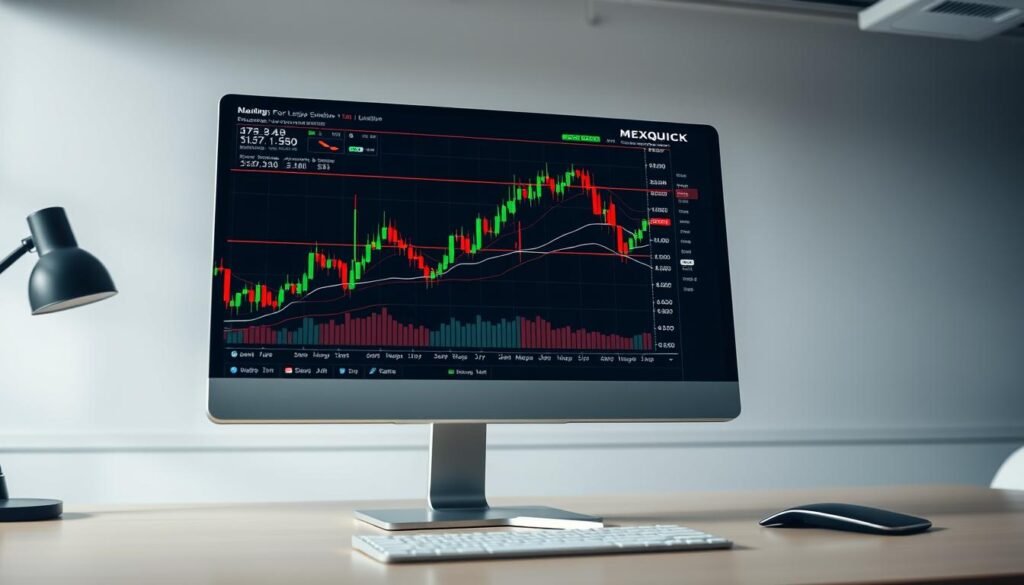
When to blend approaches for stronger signals
Combine methods by building a value range from financial work, then use technical tools to find entries near support, set stops, and scale out into strength.
Traders often lean on charts for execution even when a company thesis drives the trade, especially around earnings or rate decisions. Maintain an analyst-like hypothesis and update it as facts change.
- Practical limit: charts without context can fail on big news; valuation alone can tie up capital.
- Best practice: define your primary strategy but accept complementary signals to improve timing and risk-adjusted returns.
The Building Blocks: Quantitative and Qualitative Fundamentals
Numbers and narrative together reveal whether a company can turn products into lasting cash flow.
Quantitative data: the numbers that define a business
Quantitative fundamentals come from audited statements: margins, ROA/ROE, debt-to-equity, liquidity, and cash generation across the three reports.
These metrics let you compare peers and spot durable value drivers in the same industry.
Qualitative factors: moats, management, and brand
Qualitative inputs cover business model, moat, management credibility, governance, patents, and brand equity.
These traits explain why a company may sustain pricing power and defend market share over time.
Top-down and bottom-up: two practical workflows
Top-down starts with macro and industry demand, then narrows to companies with sound metrics and fair valuations.
Bottom-up begins at the company level—unit economics, cash, and execution—then checks industry sensitivity and scenario risk.
| Workflow | Start point | Primary focus |
|---|---|---|
| Top-down | Macro & industry | Sector demand, policy tailwinds, industry structure |
| Bottom-up | Single company | Unit economics, margins, management, moat |
| Hybrid | Screen then validate | Macro screens + company-level proof of execution |
Analysts weigh both data types; numbers without context or context without numbers can misstate value. Document assumptions on demand, pricing, and costs to track the thesis over time.
Reading Financial Statements the Beginner-Friendly Way
Reading a company’s financial reports turns piles of numbers into clear signals about strength and risk.
Income statement: revenue, expenses, margins, and growth
Start with the income statement to see revenue trends and expense control. Check whether top-line growth comes with improving margins or rising costs.
Gross margin shows pricing power. Operating margin shows efficiency. Net margin combines taxes and interest that affect equity holders.
Balance sheet: assets, liabilities, leverage, and risk
The balance follows the rule: assets = liabilities + equity. Look for cash, receivables, inventory, PPE, and debt items.
Leverage and liquidity shape downside protection. High short-term debt or hidden contingent liabilities raise risk for investors.
Cash flow statement: operations, investing, financing, and quality of earnings
Operating cash flow is the clearest signal of business health. Investing and financing flows show capital choices.
Reconcile net income to operating cash to test quality of earnings. Persistent gaps can warn that profits may not convert to cash.
Notes, MD&A, and auditor’s report: hidden insights and red flags
Read MD&A for management’s view on drivers and outlook. Notes reveal accounting policies and one-time items.
The auditor’s opinion matters: qualifications or adverse reports demand deeper scrutiny or avoidance of the company.
| Statement | Primary focus | Investor takeaway |
|---|---|---|
| Income Statement | Revenue, expenses, margins | Is growth profitable or just higher sales? |
| Balance Sheet | Assets, liabilities, equity | Liquidity and leverage; downside protection |
| Cash Flow | Operating, investing, financing cash | Cash generation and capital allocation quality |
| Notes & MD&A | Policies, contingencies, management view | Hidden risks and forward guidance |
Practical tip: build a checklist to compare the same items across reporting periods. That helps spot improving value or signs of deterioration before the stock market reacts.
Essential Financial Ratios and What They Signal
Ratios turn financial statements into practical signals you can use to judge a company’s health and prospects.
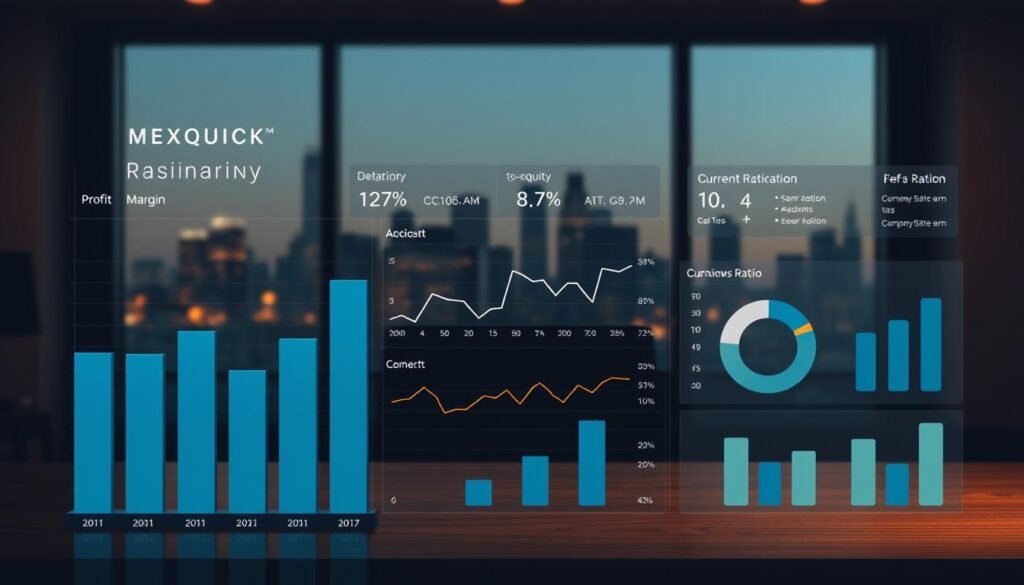
Profitability: margins, ROA and ROE
Gross, operating, and net margins show cost control at different levels. Gross margin reflects pricing and direct costs. Operating margin adds overhead and shows operating discipline. Net margin accounts for taxes and interest.
ROA and ROE explain how well a company converts assets and equity into earnings. Higher returns usually signal efficient use of capital and competitive advantage.
Liquidity and solvency: short- and long-term stability
Current and quick ratios test near-term obligations. These are vital for cyclical or cash-intensive businesses.
Debt-to-equity and interest coverage reveal long-term risk and refinancing sensitivity. Strong coverage reduces the chance that market shocks force distress.
Efficiency and valuation: turnover and price metrics
Asset, inventory, and receivables turnover show how effectively management turns assets into sales and cash. Compare them with peers for context.
Valuation ratios—P/E, P/B, P/S, and dividend yield—translate company fundamentals into what the market will pay. Use them with a value estimate: a low P/E can hide low growth or risk, while a premium multiple may be justified by durable economics.
- Combine ratios with a value range to avoid traps and align expectations with market price.
- Compare across peers and time to spot improvements, red flags, or inflection points.
- Adjust weights by model: emphasize cash flow and leverage for capital intensive firms, margins and ROE for asset-light companies.
Macroeconomic Factors That Move Markets
Macro shifts set the backdrop for every company valuation and trading decision. GDP growth, inflation, and employment trends change demand and shape revenue expectations across sectors. That, in turn, alters how investors value cash flows and future company performance.
GDP, CPI, PPI and employment
GDP growth signals whether the economy is expanding or slowing. Faster growth usually boosts demand and lifts company sales; slower growth pressures margins and lowers expected value.
CPI tracks consumer prices while PPI follows producer costs. Persistent inflation tends to push central banks to raise interest rates, which raises discount rates and compresses equity multiples.
Interest rates, the yield curve, and policy
Central bank policy rates and balance sheet moves shape credit availability and the cost of capital for firms. When policy rates rise, borrowing costs climb and capital projects can be delayed.
The yield curve shows market expectations for future rates and growth. A steepening curve often implies stronger growth; an inversion can warn of a slowdown and hurt bank margins.
Trade, supply-demand shocks and news catalysts
Trade balances affect currency demand. Persistent deficits can weaken a currency, changing import costs and multinational revenue when converted back to the home currency.
Supply or demand shocks—like shortages or surges in input prices—move margins quickly. Policy announcements or geopolitical news can reprice assets within hours.
Real-world example and scenario planning
For example, higher U.S. interest rates often strengthen the dollar. A stronger dollar can pressure dollar-priced commodities and hit exporters’ earnings, prompting sector reratings.
Build scenarios (soft landing vs. slowdown) and test how shifts in rates, inflation, currency, and supply affect portfolio value and a company’s future cash flows.
Where to Find Reliable Data and Company Fundamentals
Start your data hunt where primary documents live: filings and investor disclosures. That gives investors a factual base for interpretation and a way to check claims against records.
SEC’s EDGAR, 10-K/10-Q/8-K, and investor relations pages
EDGAR hosts the 10-K for audited annual detail, 10-Q for quarterly updates, and 8-K for material events. Use MD&A, notes, and the auditor opinion to test the company’s story.
Investor relations pages add earnings slides, press releases, and call transcripts that reveal management’s short-term view.
Financial platforms, broker research, and industry journals
Free sites like Yahoo Finance, Google Finance, and MarketWatch provide quick ratios and headlines to triage companies.
Premium providers (Bloomberg, FactSet, Morningstar) give standardized data and modeling tools used by analysts and pros.
Broker research and trade journals offer sector context, but watch for coverage biases tied to underwriting or commercial ties.
How to cross-check sources and avoid biased information
- Reconcile key figures back to filings.
- Compare the same item on two independent platforms.
- Verify management claims against third-party datasets or peer results.
- Keep a sourcing checklist with direct links to primary documents.
| Source | Best use | Watch for |
|---|---|---|
| SEC EDGAR | Primary filings: 10-K, 10-Q, 8-K | Complex notes that need careful reading |
| Investor Relations | Earnings slides, transcripts, presentations | Management spin on short-term issues |
| Free platforms | Quick ratios, charts, news alerts | Occasional data lags or standardization gaps |
| Premium providers | Standardized historical data, screening tools | Costly; not all users need full access |
Strategy: build a repeatable way to collect and validate data so your company work stays consistent and defensible over time.
Using Fundamental Analysis in Trading and Investing
Turn economic reads and corporate metrics into a repeatable playbook for markets you trade. Apply the same logic across assets, then tailor focus and time frame to each market’s drivers.
Stocks, forex, commodities, bonds, and indices: what to focus on
Stocks: prioritize revenue growth, margins, cash flow, balance sheet strength, and competitive advantage. These items drive long-term value and near-term price moves when surprises occur.
Forex: watch interest rate differentials, inflation trends, GDP, and trade balances. The dollar often reacts fast to policy moves and employment news.
Commodities: monitor supply constraints, demand trends, inventories, and geopolitics. These factors shift price independently of any single company.
Bonds & indices: focus on rates, credit quality, duration risk, and aggregate earnings trends. Indices reflect sector weightings and broad growth expectations.
Step-by-step beginner workflow: from thesis to risk management
- Define a clear thesis: what will change supply or demand, price, or company cash flow?
- Map catalysts: earnings, CPI, central bank meetings, or inventory reports.
- Set entry criteria and sizing rules tied to thesis confidence.
- Predefine stop-loss and take-profit aligned with thesis invalidation.
- Review outcomes and iterate to improve the strategy.
Limitations to respect: time, lagging data, and valuing intangibles
Work takes time and reported figures often lag real conditions. Accounting choices can obscure true cash generation. Intangibles like brand or leadership matter but are hard to value.
“Build safety margins and scenario ranges; trade the plan, not the hope.”
| Asset | Primary focus | Key risk |
|---|---|---|
| Stocks | Revenue, margins, cash flow | Guidance misses, leverage |
| Forex | Rates, inflation, trade balance | Policy surprises, rapid news moves |
| Commodities | Supply, demand, inventories | Geopolitics, weather shocks |
| Bonds/Indices | Rates, credit, aggregate earnings | Duration risk, recession pressure |
Practical example: if you expect rising policy rates, the dollar may strengthen, rate-sensitive stocks may weaken, and short-duration high-quality bonds could outperform.
Conclusion
This article is a practical guide to build a repeatable way of working. Use the steps here to link company records with macro signals and form a clear investing plan.
The core idea: fundamental analysis helps investors and traders estimate intrinsic value by pairing numbers with context. Read filings, check ratios, and weigh management quality. Keep a documented thesis and a checklist.
Build a repeatable process and focus on durable drivers: profitable growth, strong balance sheets, and credible management. Start small, practice in a demo account, and size positions prudently.
Watch macro variables—rates, inflation, and growth—so company-level views align with the market backdrop. Use this guide as a living framework to improve decisions over time.
FAQ
What is the core idea behind Fundamental Analysis: Unlock Financial Success?
It’s a method to estimate a business’s intrinsic value by examining financial statements, industry position, and economic drivers. The goal is to spot stocks or assets where market price and real value diverge, creating opportunities for investors and traders to earn returns while managing risk.
How does intrinsic value differ from market price in simple terms?
Intrinsic value reflects a company’s true worth based on earnings, assets, growth prospects, and risks. Market price is what buyers and sellers currently pay. Short-term sentiment, liquidity, and news can push market prices away from intrinsic value; the gap can be a chance to buy undervalued assets or avoid overvalued ones.
How do investors and traders use this approach to make better decisions?
Investors build long-term positions after verifying cash flow, margins, and competitive advantages. Traders apply similar evaluation to choose stronger sectors and time entries, combining it with risk controls like stop-losses and position sizing. Both use data, forecasts, and scenario planning to reduce surprises.
What’s the main difference between Fundamental Analysis and Technical Analysis?
One focuses on a company’s economic health and value drivers; the other studies price charts and volume for patterns and momentum. The first explains why an asset should be worth more or less, while the second times entries and exits based on market behavior.
When should you blend intrinsic-value work with price-action signals?
Use value-based research to select candidates and price-based tools to refine timing. For example, confirm a long-term buy thesis with improving trend, volume breakout, or favorable moving-average alignment to reduce timing risk.
What quantitative data matters most when assessing a company?
Key items are revenue growth, margins, net income, free cash flow, and balance-sheet strength. Look at leverage, working capital, and trends over several periods to judge sustainability and scalability.
Which qualitative factors can tilt an investment decision?
Management quality, brand strength, regulatory environment, and durable competitive advantages (moats) shape long-term outcomes. Corporate governance and industry dynamics also affect risk and upside potential.
What’s the difference between top-down and bottom-up research workflows?
Top-down starts with macro conditions—GDP, inflation, rates—then narrows to sectors and companies. Bottom-up begins with company-level study and builds a thesis regardless of macro. Many investors combine both to align stock picks with broader cycles.
How should beginners read an income statement without getting lost?
Focus on revenue trends, gross and operating margins, and net profit. Watch for one-off items that distort results. Consistent revenue growth with stable or rising margins is a good sign of healthy operations.
What should I check on a balance sheet to assess risk?
Examine total assets versus liabilities, debt levels, and liquidity measures. High leverage raises vulnerability to rising rates or downturns. Current assets relative to current liabilities show near-term solvency.
Why is the cash flow statement vital for quality of earnings?
Cash from operations shows whether reported profits convert to real cash. Strong free cash flow versus net income suggests reliable earnings. Large discrepancies or frequent financing cash inflows can be red flags.
Where do notes, MD&A, and the auditor’s report add value?
They explain accounting choices, contingencies, related-party transactions, and management’s view of risks and strategies. Audit qualifications or repeated accounting changes are warning signs that deserve scrutiny.
Which financial ratios quickly indicate company health?
Look at margins (gross, operating, net) for profitability, return on equity (ROE) and return on assets (ROA) for efficiency, and current or quick ratios for liquidity. Debt-to-equity and interest coverage reveal solvency under stress.
How do valuation ratios like P/E and P/B inform decisions?
Price-to-earnings and price-to-book help compare market price to earnings power or net asset value. Use them alongside growth expectations—low multiples may be attractive only if prospects and balance sheet are sound.
Which macroeconomic indicators most affect markets?
GDP growth, consumer price index (CPI), employment data, and central bank policy move broad markets. Inflation and interest-rate shifts change discount rates and sector leadership, influencing equity, bond, currency, and commodity prices.
How do interest rates and yield curves impact stock and bond markets?
Rising rates increase borrowing costs and lower present value of future earnings, often pressuring growth stocks. A flattening or inverted yield curve can signal recession risk and shift investor preference toward defensive sectors and high-quality bonds.
What real-world effects appear when rates rise for currencies and commodities?
Higher rates can strengthen a currency, reducing commodity prices priced in that currency. Commodity-dependent economies may see currency weakness. Traders watch these relationships to anticipate cross-market moves.
Where can I find reliable company filings and data?
Use the SEC’s EDGAR database for 10-Ks, 10-Qs, and 8-Ks, and visit official investor relations pages. Complement filings with Bloomberg, Reuters, Morningstar, and broker research, then cross-check items across sources to avoid bias.
How do I verify data and avoid biased research?
Cross-reference filings with audited statements, compare multiple analysts’ reports, and review industry journals like The Wall Street Journal or Financial Times for context. Be skeptical of single-source claims and check footnotes for nuances.
How can I apply this method across assets like stocks, forex, and commodities?
For stocks, focus on company financials and sector cycles. In forex, emphasize macro, interest-rate differentials, and trade balances. For commodities, analyze supply-demand, inventory levels, and currency moves. Tailor metrics to each market’s drivers.
What is a simple step-by-step workflow for beginners?
Start with a thesis, gather quantitative and qualitative evidence, estimate value or scenario ranges, check macro and sector context, set entry and exit rules, and establish position sizing and stop-losses before trading.
What are common limitations to keep in mind?
Data lag, accounting quirks, and difficulty valuing intangibles like brand or intellectual property limit precision. Markets can stay irrational for long periods, so risk controls and patience are essential.
How do inflation and market news create short-term surprises?
Unexpected CPI prints, supply shocks, or geopolitical events can shift sentiment and liquidity rapidly. Even companies with strong fundamentals can see volatile price moves, so maintain cash buffers and defined risk limits.
Can professional research help retail investors, and where to find it?
Yes. Sell-side reports from Goldman Sachs, Morgan Stanley, and independent research from Morningstar or independent advisory services provide useful context. Always validate recommendations against company filings and your own models.