
This guide explains how applying a clear trading plan to historical data helps you see how a approach might have performed. It does not promise future success, but it offers a practical way to compare options and set realistic expectations about potential performance.
The process applies defined rules to past market data to generate hypothetical trades and evaluate results. That lets you measure volatility, fees, and slippage so simulated P/L more closely matches live accounts in the United States.
Platforms such as MetaTrader 4 (Strategy Tester for EAs) and ProRealTime (ProBacktest) provide detailed equity curves and order stats. After simulation, forward testing on a demo account helps validate the plan on unfolding markets before risking real capital.
Treat this work as due diligence. Document rules, model transaction costs, and move from simulation to paper trading, then to controlled live deployment with disciplined risk controls.
Key Takeaways
- Apply rules to historical data to test a trading plan before using real funds.
- Model fees, spreads, and slippage to reflect live account P/L.
- Use MT4 and ProRealTime for detailed reporting and equity curves.
- Follow simulations with demo (paper) testing on live markets.
- Document parameters and manage risk for a smooth transition to live trading.
What Backtesting Is and Why It Matters Today
Testing a trading plan on historical data means turning rules into entry and exit signals and producing a simulated profit-and-loss track record.
This process helps traders filter out weak approaches before committing time or capital. It acts as disciplined research that highlights which setups survive different market conditions.

Modeling matters: testing lets you estimate fees, slippage, liquidity limits, and latency so performance estimates are closer to reality. It also creates a safe space to tune a trading strategy, provided you guard against overfitting.
Verification uses known metrics such as Sharpe ratio and maximum drawdown to confirm that implementation and results match expectations. Keep in mind this work is an idealized upper bound — higher-frequency plans are harder to model because execution details matter more.
- Filter: discard underperformers early.
- Model: include costs and real-world frictions.
- Verify: compare risk-adjusted metrics.
- Document: record parameters so tests can be replicated.
How Backtesting Works: From Historical Data to Strategy Performance
Map explicit entry and exit conditions to past price bars so each hypothetical trade is reproducible. This step-by-step approach turns a written plan into signals you can run over historical data and measure.
Signal generation: define deterministic criteria for entry and exit so every trade is unambiguous. Use simple rules (for example, a moving-average crossover): enter when the fast MA crosses above the slow MA; exit when it crosses below.

Process flow: apply rules bar-by-bar, log each round-trip trade, and compute cumulative P&L to assess strategy performance. Record timestamps, price, size, fees, and notes to support later analysis and audits.
“Clean, chronological data and strict signal definitions are the backbone of reliable tests.”
- Protect against look-ahead bias when referencing intraperiod high low values; ensure calculations use prior bars only.
- Model commissions, spreads, and slippage that vary by market and time of day to reduce divergence from live outcomes.
- Align bar intervals and session hours with actual trading time to avoid unrealistic fills.
Reproducibility: version control your code and parameters so later analysis remains valid. Good logging and clean data make results trustworthy and actionable.
Backtesting Strategies: A Practical, Step-by-Step Workflow
Begin with a tightly defined rule set so every simulated trade is repeatable and objective.
Define rules and parameters
Write explicit entries, exits, position size, and risk limits. Use plain-language rules so a coder or platform reproduces each decision without interpretation.
Select markets and data
Choose symbols and a data window that yield 30–50 trades for meaningful results. For intraday work, 2–3 months on 15-minute bars often suffices; for swing styles use 6–12 months.
Run tests and avoid curve fitting
Run a single pass that logs multiple exits (2:1, 3:1, EMA trails) to compare outcomes quickly.
“Validate tweaks on fresh data, not the same sample used to optimize.”
Document trades and keep a change log
Save entry/exit screenshots, timestamps, and notes in a spreadsheet or journal like Edgewonk. Maintain a versioned change log for parameters so analysis stays auditable.
- Keep rules unambiguous and parameter values fixed per test.
- Target 30–50 trades for statistical power.
- Record setups, outcomes, and the exact data range used.
Measuring Results: Performance Metrics That Matter
Measure outcomes by starting with R-multiples and total P&L to see whether the plan truly made money.
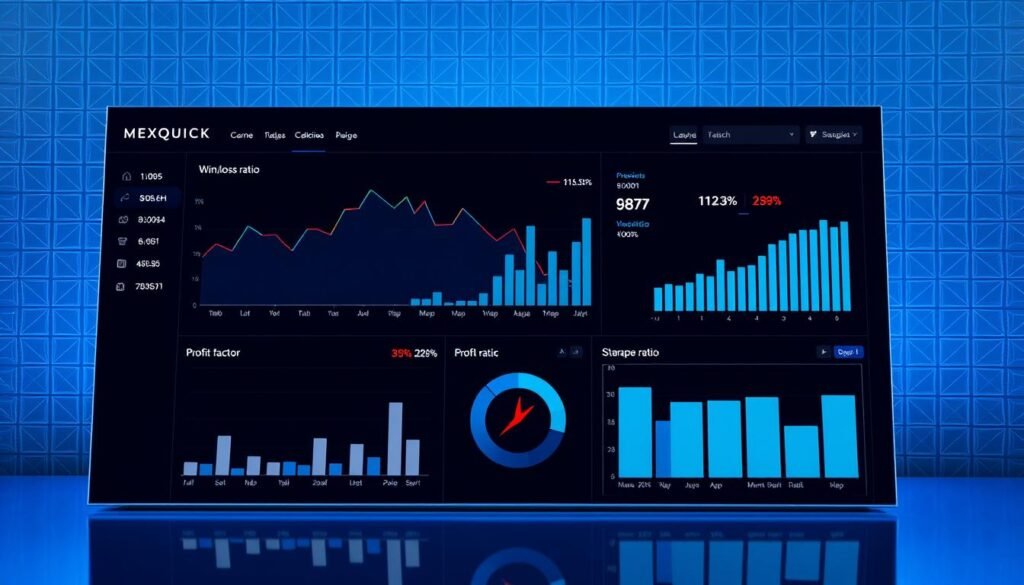
Headline metrics give immediate context. Report total profit, average and cumulative R-multiples, and expectancy to confirm the trading strategy creates a sustainable edge.
Profit, R-multiples, and expectancy
R-multiples show how many times risk was paid per trade and reveal if marginal gains rely on lucky draws.
Expectancy combines win rate and payoff to show the average return per unit risk.
Win rate, holding time, and losing streaks
Review win rate alongside payoff ratio; both determine psychological sustainability for traders.
Track average holding time so the plan matches your time availability and discipline.
Analyze streaks to set drawdown limits and test whether you can follow the plan through rough patches.
Risk-adjusted metrics and drawdown
Calculate Sharpe ratio to compare returns versus volatility.
Map maximum and average drawdowns for capital planning and position sizing decisions.
Equity curve shape: steadiness vs reliance on outliers
Inspect the equity curve for smooth, steady growth. If a few outlier trades drive most gains, the results are fragile.
Segment results by instrument, session, and setup to find where the strategy performs consistently.
“Prefer configurations that deliver the best risk-adjusted outcome, not just the highest raw return.”
- Start with headline results: total P&L, average R, and expectancy.
- Compare win rate and payoff ratio to understand expectancy and trader psychology.
- Measure holding time, losing streaks, Sharpe, and drawdowns for risk planning.
- Inspect the equity curve for reliance on outliers and segment by market and session.
Biases and Pitfalls That Distort Backtests
Many apparent edges vanish once you remove hidden biases from your historical tests. Below are common traps and clear checks to improve your analysis.

Optimization bias and curve fitting
Optimization bias happens when too many parameters tune noise into a false edge. Use sensitivity analysis and fewer moving parts to confirm stability.
Look-ahead and intraperiod errors
Off-by-one indexing or using intraperiod high low without lag creates impossible signals. Code reviews and walk-forward checks catch these bugs.
Survivorship and dataset completeness
Exclude delisted names or use survivorship-bias-free feeds. Shorter, recent windows often reflect current market structure better.
Psychological tolerance and time-of-day
Forecast drawdowns can make traders stop trading. Verify that signals occur at tradeable time and that you can endure stretches of losses.
“Make sure you stress-test the plan under worse slippage and fees than expected.”
| Issue | Root Cause | Quick Fix | Confidence Check |
|---|---|---|---|
| Optimization bias | Excess parameters | Sensitivity analysis | Validate on unseen data |
| Look-ahead bias | Coding errors / intraperiod data | Lag inputs; code review | Replay bar-by-bar |
| Survivorship bias | Missing delisted assets | Bias-free dataset | Compare older vs recent window |
Final checks: run peer reviews, walk-forward validation, and parameter fences. Assume slippage and costs can be worse live so you don’t unexpectedly lose money.
Tools and Software for Backtesting in the United States
Choose tools that match your workflow: rapid prototyping, rigorous statistics, or direct broker integration. The right stack speeds development and reduces implementation risk.
Python, R, and MATLAB suit different needs. Python offers fast development and libraries like NumPy/SciPy for robust analysis and broker APIs (Interactive Brokers). R excels for deep statistical research and econometrics. MATLAB provides polished numerical toolboxes and vectorized performance for heavy math.
Excel is useful for quick prototypes and reports. VBA can add features but may obscure logic and fail at scale. For production, code-first environments avoid spreadsheet errors and improve reproducibility.
“Prototype in a high-level language, validate with rigorous tests, then move to a production-capable stack.”
Integration, cost, and bias controls
APIs let Python and R unify testing and live execution. Vendor platforms may lock you to a broker and raise costs. Use version control, unit tests, and reproducible data pipelines to limit bias and mistakes.
| Environment | Strength | Limitations |
|---|---|---|
| Python | Fast development, rich libraries, broker APIs | Requires coding discipline |
| R | Advanced statistics and econometrics | Less broker support than Python |
| MATLAB | Vectorized math, toolboxes | Licensing cost; vendor lock-in |
| Excel | Quick prototypes, familiar UI | Error-prone, poor at scale |
- Pragmatic path: prototype in Python or R, validate with MATLAB or parallel runs, keep Excel for simple reporting.
- US notes: check broker API availability, data fees, and platform terms before committing to a vendor.
Platform Walkthroughs: MT4 Strategy Tester and ProRealTime ProBacktest
A focused walkthrough makes it easier to run tests, read reports, and document results across both platforms. The steps below keep your setup consistent so you can compare output without confusing platform differences.
MT4 setup
Install the EA, attach it to the chart, and open the Strategy Tester. Select symbols, set the model (tick/ohlc), choose a date range, and set parameters like stop-loss and take-profit.
MT4 analysis
Run the test and review P/L percentage ratios, counts of winning vs losing trades, and basic risk stats. Use input optimization sparingly to avoid overfitting.
ProRealTime: quick launch
Open the indicators & trading systems window, pick the system, set date ranges, start time, and capital, then run ProBacktest. Keep the same instrument and time window you used in MT4.
ProRealTime insights
Inspect the equity curve highs and lows, review the orders list, and check closed positions for entry exit timestamps. Export reports and save templates for reproducibility.
“Run a test on a demo account before any live deployment; reports are informative but not guarantees.”
| Platform | Key Steps | Primary Output |
|---|---|---|
| MT4 | Install EA, set model, run tester | P/L ratios, trade counts, optimization logs |
| ProRealTime | Choose system, set dates/time, run ProBacktest | Equity curve, orders list, entry/exit stats |
| Practical tip | Use same instruments and periods | Isolate platform vs market differences |
From Backtest to Live Trading: Forward Testing and Risk Management
Forward testing lets you observe how a written plan behaves in real-time market flow before allocating capital. Use this step to ensure the trading strategy performs under live order execution, quotes, and session changes.
Paper trading and demo accounts
Run the system on a demo account to test without risking capital. Document each entry, exit, and order attempt.
Platforms like MT4 and ProRealTime offer demo modes and walk-forward tools to mirror live conditions.
Position sizing, fees, and adapting to market conditions
Set risk per trade using historical drawdowns and your tolerance. Keep position sizes small at first.
Model real costs: record spreads, commissions, and slippage during the demo run to refine realistic performance expectations.
Monitor volatility and liquidity. If the market conditions change, apply pre-defined adaptation rules rather than ad-hoc changes.
“Only graduate to live trading when pre-set performance and operational checklists are met.”
- Define graduation criteria: minimum demo duration, win-rate targets, and drawdown limits.
- Keep a daily log of trades, deviations, and lessons to tighten execution discipline.
- Use gradual capital scaling and strict risk controls when moving to live trading.
Conclusion
A disciplined testing approach turns documented rules and past data into clear, actionable guidance for real-world trading.
Treat testing as one essential part of building a robust strategy, not the finish line. Use it to set expectations, measure performance, and spot weaknesses.
Combine rigorous backtesting with forward testing, scenario analysis, and strict risk controls before moving capital. That mix improves the odds of success while keeping emotional and execution risks manageable.
No historical test can guarantee future gains. Markets change, and execution frictions can erode fragile results. Prioritize steady equity curves and psychologically tolerable profiles over short-term outliers.
Finish documentation, define walk-forward criteria, and enter a structured demo phase. With careful iteration and sober expectations, you can convert test insights into a durable trading edge.
FAQ
What is backtesting and why does it matter for my trading?
Backtesting is the process of applying a trading plan to historical market data to estimate how it would have performed. It helps traders check viability, measure risk, and refine rules before risking real capital. Proper testing highlights strengths and weaknesses, reducing surprises in live trading.
How do entry and exit rules get converted into testable signals?
You translate clear rules—like indicators, price levels, or time filters—into logical conditions that generate buy or sell signals. Those signals are applied step-by-step to historical price data so each simulated trade has defined entry, stop, and exit points for performance tracking.
What types of historical data should I use for reliable results?
Use complete, high-quality data that matches your market and timeframe: tick or intraday for scalping, minute for day trading, daily for swing approaches. Include weekends, corporate actions, and a long enough period to capture different market regimes.
How do I account for fees, slippage, and execution in tests?
Add realistic commission assumptions, spread or round-trip cost per trade, and slippage estimates based on liquidity or historical fills. Ignoring these costs artificially inflates results and leads to poor live performance.
How can I avoid curve fitting when optimizing parameters?
Limit the parameter search space, use out-of-sample testing and walk-forward analysis, and prefer robustness over peak returns. Validate on different instruments and time periods to ensure the approach generalizes.
What performance metrics should I focus on?
Track absolute profit and loss, expectancy (R-multiple), win rate, average win/loss, max drawdown, Sharpe ratio, and equity-curve consistency. These metrics together reveal return, risk, and reliability.
Why is survivorship and look-ahead bias a concern?
Survivorship bias removes delisted instruments and skews returns upward; look-ahead bias uses future data improperly. Both produce unrealistic metrics. Use historical universes and ensure signals only use information available at the time.
Which tools are common for testing in the U.S. market?
Popular choices include Python (pandas, backtesting libraries), R, MATLAB, and platform-native testers. Brokers and platforms like MetaTrader or ProRealTime offer built-in testers, while spreadsheets can be useful for simple concepts.
How do I interpret an equity curve to judge robustness?
Look for steady compounding and limited reliance on a few outliers. A smooth, rising curve with controlled drawdowns indicates robustness; jagged curves or single large gains suggest fragility and overdependence on rare events.
What practical steps form a disciplined workflow for testing?
Define rules and parameters, gather clean historical data, run in-sample tests, perform out-of-sample or walk-forward validation, record trades and notes, and iterate only when improvements are genuine—not just optimized to past noise.
How should I transition from simulated results to live trading?
Start with paper trading or a demo account using the same execution parameters. Implement strict position sizing and risk limits, monitor live slippage and fills, and phase capital gradually while tracking deviations from simulated metrics.
Can a tested plan still lose money in real markets?
Yes. Market conditions change, execution differs from simulation, and rare events happen. Stress-test for severe drawdowns, set conservative expectations, and maintain risk controls to survive periods of underperformance.
What role do time-of-day and session effects play in tests?
Time-of-day impacts liquidity and volatility. Include intraday patterns in your data and test session filters if your edge depends on opening auctions, U.S. market hours, or specific volatility windows to avoid misleading averages.
How should I document tests and trades for later review?
Keep structured logs: date ranges, parameter sets, screenshots of key trades, entry/exit reasons, and performance snapshots. Clear records help identify degradation, confirm reproducibility, and guide future research.
Are platform strategy testers like MT4 and ProRealTime sufficient?
They are useful for many approaches and provide quick diagnostics, equity curves, and detailed order reports. For advanced statistical analysis or custom logic, supplement with Python, R, or backtesting frameworks to cross-validate results.